On a Precision coaching call in August, I asked a group of founders to rate their decision fatigue from 1 to 10.
One rule: no sevens. Sevens are for people who ride the fence.
The answers ran from a couple of fours all the way up to nines. I was closer to the nines.
I'd bet even the fours are making a pile of small decisions every day without noticing. Those come out of the same account as the big ones.
Your brain is a bank account
Every decision is a withdrawal. Stress and brainpower all come out of one account.
If you have $100 and make 101 one-dollar withdrawals, you're broke. Take out $100 at once and you're just as broke.
So you don't need one crushing decision to be wrecked. A thousand tiny ones will do it.
Then the big call shows up on a Thursday afternoon. You end up making a $100,000 decision with the brainpower you should spend picking lunch.
Everybody talks about AI for speed. Very few people talk about what it does for the quality of your decisions, and for the human making them.
I teach two models for this. The Three Brain Taxes show where the withdrawals come from, and the AI Decision Ladder shows where AI can stop them.
Tax 1: The executive tax (the one you should pay)
Grab a pen and draw a big triangle. Each corner is a kind of decision, and each taxes your brain differently.
Write executive along the bottom. That's the foundation.
These are the truly hard calls. Should I hire someone? Fire someone? Change pricing, open a new marketing channel, change how we sell?
These deserve your time, your brainpower and real effort to get right.
Jeff Bezos splits decisions into two types, and it's the easiest way I know to sort them.
Type 1 is a one-way door. It's permanent, or close to it. Buying a company, firing an executive, changing what you sell at its core.
Type 2 is everything else. It's easy to reverse. A new ad, a new guarantee, a different process for the next five customers.
Watch pricing. A price change for new customers is Type 2. A price change for existing customers is Type 1, because it's hard to take back.
Type 1 decisions stay with you, maybe with a co-founder. Type 2 decisions go to your team, and you coach them on the ones they get wrong.
It's also how I decide what to delegate.
AI can help you prep and brainstorm a Type 1 call. It should not make it. Put a whole lot of human brain cells into this one.
Tax 2: The admin tax (the one most of us shouldn't pay)
Write admin on the right. This is the transactional stuff: invoicing, CRM notes, list cleanup, handoffs.
I talked to a founder on a sales call who was losing over $1M a year in sales they weren't closing. They had the leads.
They just didn't have time to sell, because admin ate the week. We did that math together on the call, from their own numbers.
Your number might be different. You're still paying it, and so am I.
Watch your sales team especially. Every minute a salesperson spends not selling is a problem to fix.
Your calendar is the most expensive document in your company. Your sales team's calendar is the second most expensive.
Admin still drains the account, and by the time a Type 1 decision shows up you're already tired and annoyed about invoicing.
Tax 3: The research tax (the sneaky one)
Write research on the left. Boy, does this one get me.
It's the tax you pay gathering everything you need to make an otherwise easy decision.
Say the decision would be easy, except it takes 45 minutes of frustration to find the inputs.
Now it isn't easy anymore.
You're paying all three taxes. The goal is to keep paying the executive tax and shrink the other two as far as you can.
Run the 60-second test
Set a timer for 60 seconds.
- Write down the last 10 decisions you made today. Don't overthink what counts.
- Label each one: exec, admin or research.
- Check the ones where AI helped you.
Seeing the list on paper hits harder than thinking about it.
Some lines won't need AI at all. No AI is better than deleting a task, or deciding to ignore it.
So cut first. Then look at what's left.
The taxes blend, too. Research often comes right before an executive call. Label the biggest part.
The AI Decision Ladder
This is how AI takes the admin and research taxes off your plate. These aren't specific tools to buy.
It's five kinds of work that AI handles well right now, in its current imperfect form. Work from the bottom up.
Rung 1: The pre-decision brief
Almost every decision starts with gathering information. Let AI gather it.
Before a sales call, I have AI pull together what the prospect wrote on the form, research their website and suggest where AI could help them.
That used to take me 60 to 90 minutes. With everything already connected, it takes about 30 seconds.
Meeting prep is the easiest place to start. We prep our own leadership meeting this way.
Ask yourself: what inputs do I need to make this call well? Then have AI put them in one summary before you sit down.
Rung 2: The exception filter
Say deals closed this week was 10. Is that good? You have to ask what's normal, what the goal is, what it was last week and how you even count a closed deal.
That's five questions for one number. Do that for every number on your scorecard and your brain is cooked.
So flip it. Have AI watch the numbers and show you only what's off track, or what moved in a bad direction.
You look at fewer things and go deeper on the ones that matter. It might bruise the ego. That's fine.
Rung 3: The first draft
Ever delegate something to an employee, get it back imperfect and decide you'll just do it yourself forever? I have.
That belief is wrong. Then AI shows up, and somehow our standards get even higher.
Set the bar at 80%. If AI gets the job 80% done, you edit, approve and send it.
That's 10 minutes instead of the two hours of staring at a blank page.
Rung 4: Open loops
This one is death to entrepreneurs' brains. Mine especially, because I commit to way too much.
Keep a running list of every open loop: what you asked people for, what they promised you and what you promised them.
I pull mine from meeting transcripts. I could never ask someone on my team to watch every call I've ever recorded and catch every commitment.
From the transcripts, AI gets about 90% of it. Then the loops show up in your follow-ups and nothing gets dropped.
Rung 5: Status updates
Where's this project at? You need the data somewhere first. We track every new customer's launch stage in our CRM.
Now I can ask AI where everyone is, with the context of what they came in to solve, without digging.
None of this is a 50-inch monitor with 57 agents running your life. It's handing you the information instead of making you go get it.
Common mistakes
- Building AI for a decision you should delete. Cut it or ignore it first.
- Delegating Type 1 decisions. To your team or to AI. Those are yours.
- Holding AI to a perfect standard. 80% and a fast edit beats a blank page.
- Killing cash flow because "my time is worth $5,000 an hour." That's only true if you spend the time you reclaim on something more valuable.
Start noticing this week
For one week, notice when you're doing something heavy on admin or research. Jot it in a notes file.
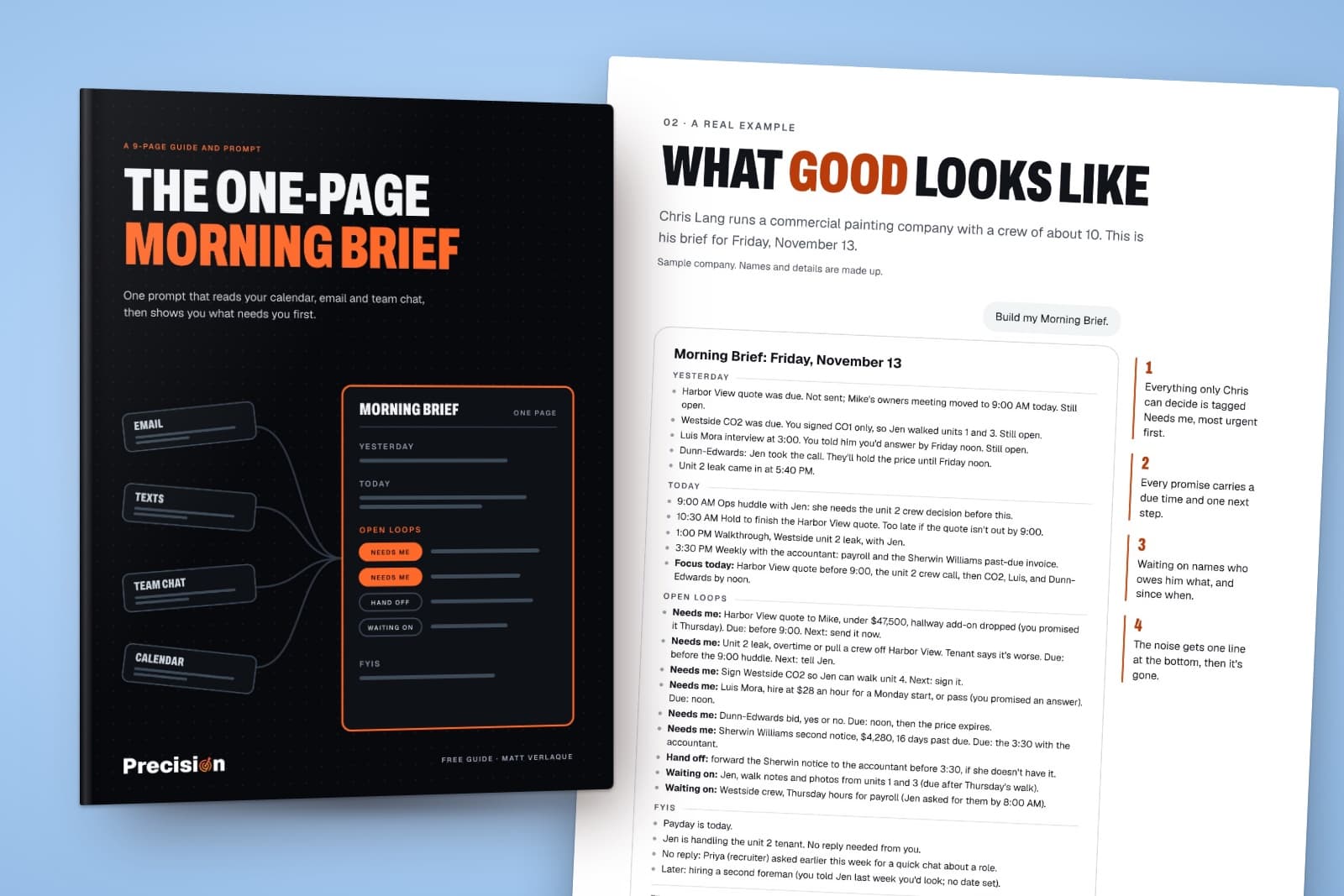
That list is your roadmap for where AI goes first. If you want a head start, the free Morning Brief guide puts your pre-decision brief and open loops on one page you read before you open Slack.