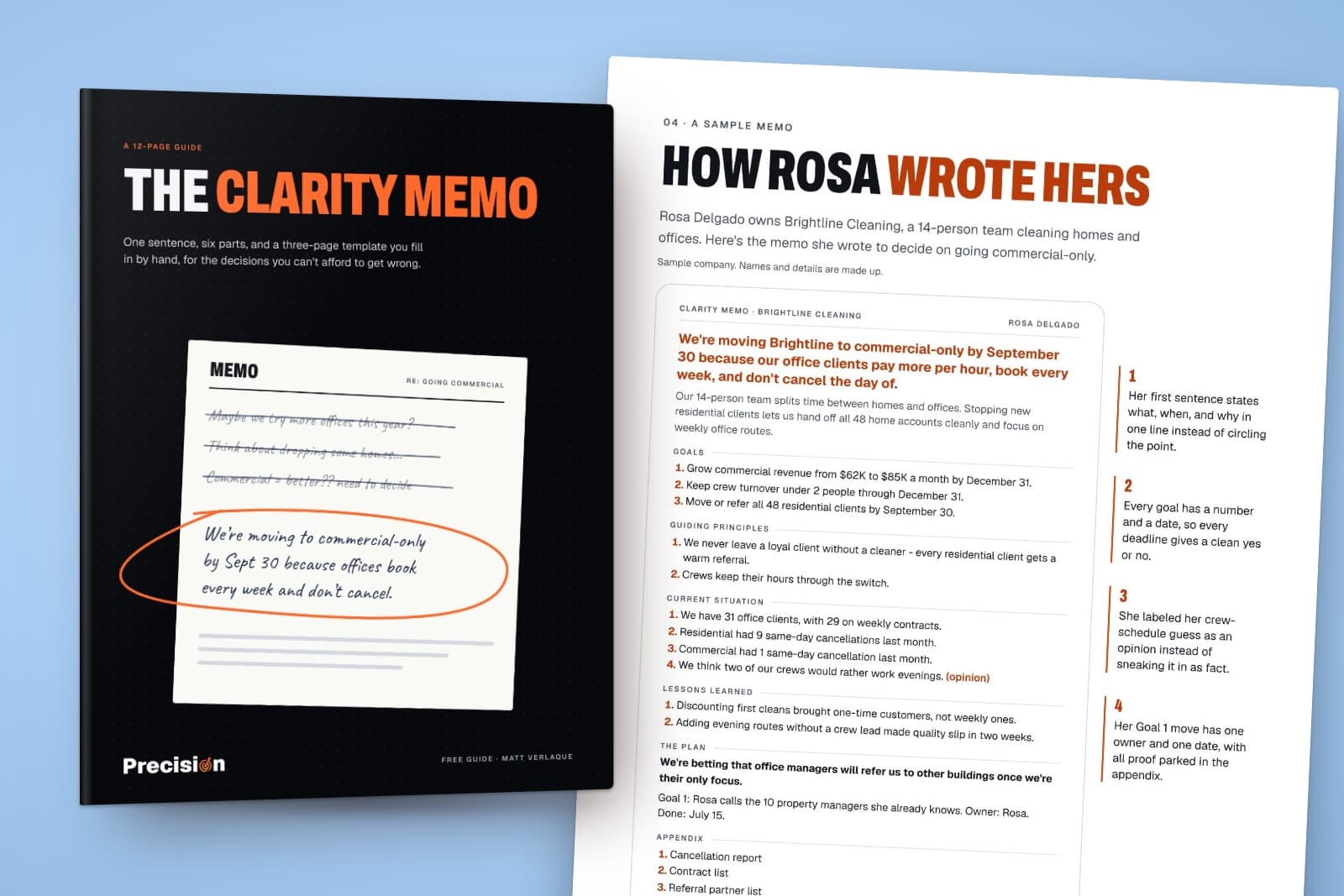
On a Precision coaching call in September, I asked a group of founders for one decision they'd thought about more than three or four times.
The chat filled up fast: a new service tier, getting out of a line of business, how much to spend on marketing, changing the pricing.
Then I asked what makes it hard, and every answer was some form of fear.
Throwing money at something that might not work. A tight budget with no room to get it wrong.
Most big decisions are fear in disguise. The Clarity Memo is how I think mine through before I bet real money.
Where it comes from
I stole it from Jeff Bezos, who banned PowerPoint at Amazon in 2004.
His reason: slides are easy for the author and hard for the people reading them. A memo flips that.
What works at Amazon's size won't fit every company. So I blended Amazon's six-page memo with Procter & Gamble's one-pager, which is often not one page.
Then I cut it down to the parts that work for me. I've used it for years.
Draw it as a ladder
The memo has seven sections, top to bottom, in two halves.
The top half sets the frame: what are we trying to do, and what rules will we follow? The bottom half is the actual thinking.
You don't touch the bottom half until the top is done. Think of it as signing your own permission slip.
1. The intro: one sentence
Every memo opens with one bold sentence, in its own paragraph, that covers the entire scope. A couple of supporting paragraphs can follow.
When you start, that sentence will feel impossible. That's fine.
I usually begin at the intro and end at the intro. Only once the rest of the thinking is done can I boil it down.
If you can't sum up what you're talking about in a single sentence, you don't yet know what you're talking about.
Skip this and the rest turns into word vomit. Walls of text, AI slop, whatever you want to call it.
2. Goals
Write SMART goals, and give every one a date. Time-bound is the part people forget.
Goals keep the memo from turning into catharsis and therapy. A brain dump feels great, and it's still not a plan.
If the memo can't tell you whether the plan worked, you're not focused.
3. Guiding principles
This one feels a little fluffy. The first time I read it in Amazon's playbook, I thought it was the dumbest thing ever.
It took me a couple of years to get it.
Guiding principles are the values you check the plan against. The test for a good one: the opposite could also be valid.
"Move fast and break things" passed that test for early Facebook.
If you run the software behind a bank, "be deliberate and protect uptime" is just as valid.
"Integrity" fails it. Nobody's principle is "lie to customers." That's table stakes, like breathing air.
Write the ones you're most likely to break. One of ours at Precision is do less things better, because I need the reminder.
We all get too close to a project and lose the plot. Principles pull you back.
This section is the dividing line. Everything above it is the frame, and everything below is the work.
4. Current situation
This is the section you'll want to skip, and it's the one that'll sink you.
Founders are optimists, because pessimists don't start companies. That optimism serves us almost everywhere, except in a plan we actually need to hit.
Ever set a wildly optimistic growth plan and hit 30% of it? Most of us have.
So the current situation holds two things: metrics and provable facts. No feelings.
Picture me on your shoulder. Every time you write a line, I say, "Prove it."
Can you show me the numbers, the customer conversations, the behavior? If not, go research it, or call it an opinion.
Opinions have a place in the plan. A fact and a bet are different things, so label which is which.
5. Lessons learned
Unless it's day one of your business, you've learned a thing or two. Nobody writes a memo to do more of what's already working.
My philosophy on mistakes is simple. Make as many as you can, and each one only once.
The only way to do that is to write the lessons down. This is my format:
- A numbered list, so the team can say "I disagree with lesson three."
- One short sentence, then one or two supporting sentences.
- No sub-bullets. Brevity is the feature.
- A full root-cause write-up goes in the appendix, with a one-line pointer to it.
6. The strategic plan
Five sections before you write the plan. That's how you know this is different.
I keep the plan loose, with one rule. It opens with one sentence called the bet.
What bet are you making?
For this, read Annie Duke's Thinking in Bets. She was a professional poker player, and I'd call it mandatory reading.
Business is the same game. We control few of the variables, and we still have to make the best call.
After the bet, break the plan into whatever subsections the decision needs.
7. The appendix
Push as much down here as you can. Research, data, the root-cause analysis, the proof behind every fact.
My appendix usually runs two to three times longer than the memo. That's on purpose.
Anyone who wants the extra reading can have it, and nobody else has to wade through it.
Make it easy to scan
Most people are scanners. So I bold the lines I need read, and sometimes change their color.
If most of your team will scan it, you get to decide what they see.
Then I edit it a few times and circulate it for comments.
Most of my memos never leave my team. They still get me a ton of clarity.
Where AI helps, and where it doesn't
I use the heck out of AI for research. On one memo, it pulled competitor pricing and packaging in about four minutes.
That would have taken me 12 hours. It all went straight into the appendix.
I'll also have AI suggest what a section could say, in a window next to the doc.
Every word that goes into the memo still goes to my eyes, to my brain, to my hands. I type every section above the appendix myself.
If you outsource the critical thinking to AI, skip the memo. Ask it what to do and hope it works.
I wouldn't bet on that.
AI chews through information faster than we do. Making the call is still your job, and it's why you're in the seat.
Stress-test it
When the memo is done, run it through Jason Cohen's Rude Q&A. It's an AI skill he built to go with his book Hidden Multipliers.
It's exactly what it sounds like. The AI attacks your positions and makes you defend every one.
Common mistakes
- Writing the intro once. Start there, then rewrite it last.
- Goals with no date. You'll never know if the plan worked.
- Principles nobody would argue with. If the opposite can't be true, it isn't guiding anything.
- Skipping the current situation. Your plan starts from a place you aren't.
- Long lessons. The detail goes in the appendix.
- Letting AI write it. Research, yes. The thinking is yours.
I can't promise your plan will work. I can promise you'll run it with more clarity and focus than if you'd skipped this.
The one I was writing the week I taught this took seven hours of hands on the keyboard.
I tend to just go. This forces me to think first.
Start with one decision
Grab the free guide for the printable template and a finished sample memo, then write yours on the decision you keep chewing on.