Does it feel like everyone else figured out AI while you missed the memo? Most of us feel that way.
There's a new tool every week that's supposed to run your whole company. So we go shopping.
We try the shiny thing and end up with a solution in search of a problem.
The task comes first, not the tool. Find the work that's already eating your week, then pick the smallest tool that fixes it.
Why not just pick a good AI tool and learn it?
Because you'll burn a lot of time, money and focus trying to shoehorn it in somewhere.
Every build costs more than the subscription. It costs your focus and your calendar.
Some wasted builds are the tax you pay for trying new things. Just don't make a habit of it.
The other trap is all-or-nothing thinking. You don't need a custom AI empire.
Replace tasks, not roles or people.
How do I find the right first task?
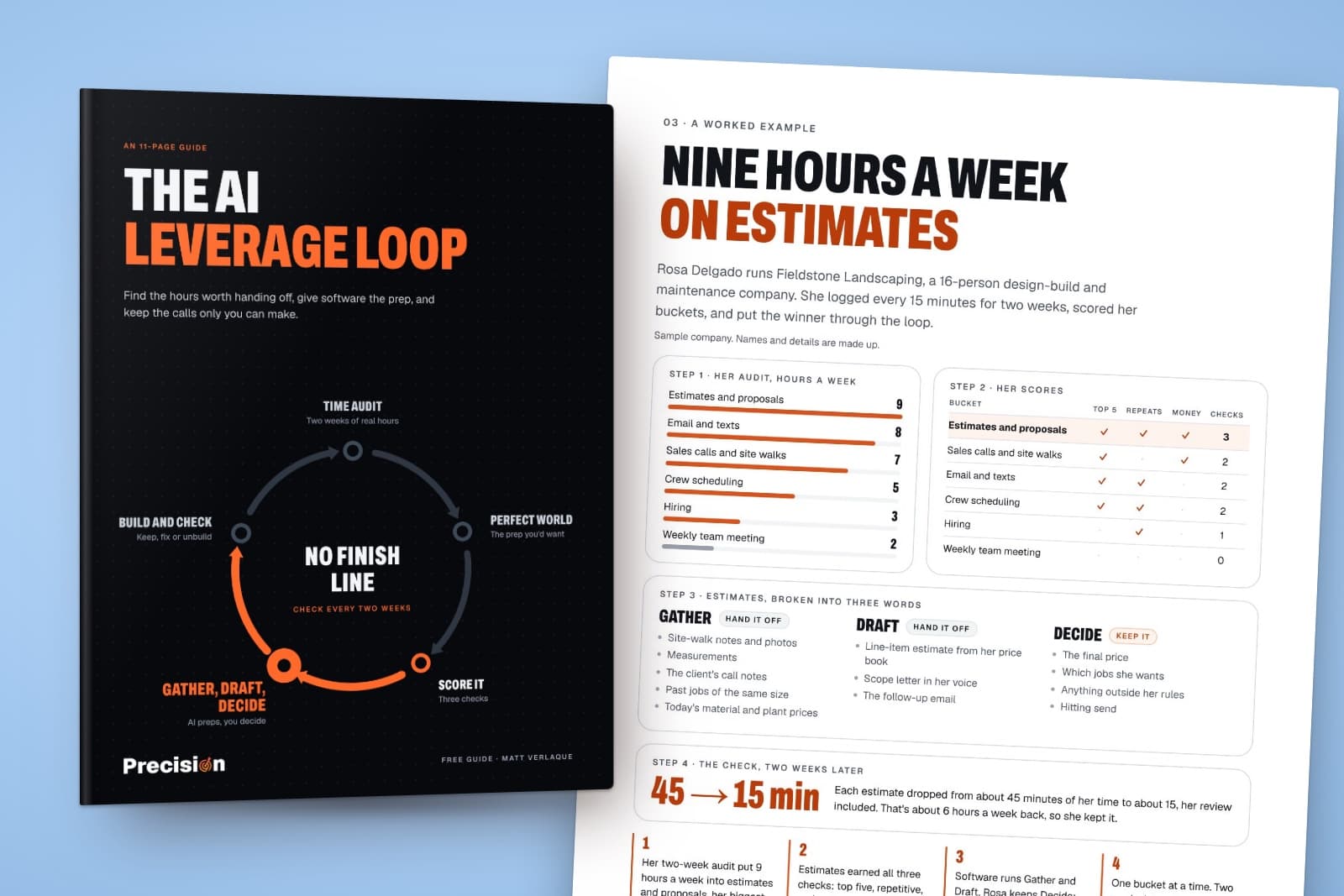
Run a time audit. For two normal weeks, write down what you did every 15 minutes.
It feels a little weird. That's why it works.
Then group every line into buckets like quotes, sales calls, scheduling or email. Total the hours for each one.
Give each bucket up to three check marks:
- Is it one of my top five places I spend time?
- Is it repetitive? Most of us don't love repetitive prep, and when we don't like doing stuff, we don't do it.
- Does it make or keep money? Revenue and profit are the two scoreboards of business.
Three checks means you invest there. That's the whole scoring system.
Notice who's missing: the good idea fairy. She flies in, drops off "sure would be cool if" and flies away.
Real hours keep her out. You only solve problems that exist.
What part of the work should AI actually do?
Almost every process breaks into three parts: gather, draft and decide.
Gather is pulling the inputs together, like notes, transcripts, customer history and research.
Draft is turning those inputs into a first version. Decide is your judgment and the final call.
Automate gather and draft. Be much slower to automate decide.
Treat AI the way you'd treat a human copywriter. They'd interview you, write the draft and put it on your desk.
You'd still edit it, because it's your name and your voice on the line.
Should I use AI for something I've never done?
No. If you've never done it in your business, AI isn't the place to start.
Use it to stop doing work you already do, or to finally do the work nobody has time for.
Then spend the time you free up on new ideas. Innovation is still a human job.
What does a good first win look like?
A founder running a local service business shared one on a coaching call in October.
Nobody on the team had time to read the local business journal and the area magazines every morning. That work was never going to happen.
So AI reads all of it. It builds a hit list of new companies in town and recent events the team can follow up on.
The report lands first thing in the morning. The founder picks the best leads and hands them to the business development person to go hunting.
That's gather and draft on rails, with a human still deciding.
How do I know if it's working?
Check it after two weeks. Is it saving time? Is it saving or earning money?
If yes, keep it and run the same loop on your next bucket.
If not, fix it or unbuild it. That's allowed.