On a Precision coaching call in October, I asked a group of founders a simple question.
Who here has felt pressure to figure out where to put AI in the business?
Pretty much every hand went up.
Then I asked who had built something that turned out to be an epic waste of time.
One team spent six months on a course that never sold. Another founder spent three months modeling a commission plan nobody used.
A third hired an "AI guru" and fell down rabbit hole after rabbit hole.
I've done it too. I've burned weeks of hardcore sprinting on software that didn't take or got shut down.
Too often, AI ends up as a solution in search of a problem. The AI Leverage Loop is the antidote.
Start with one belief
Putting AI into your business isn't a task. There's no finish line.
Think of it like revenue. You don't make revenue once, check the box and move on to something else.
Marketing and leading your team are permanent parts of the work. Finding where AI helps is now one of them.
The starting time was yesterday, and the finish line is never.
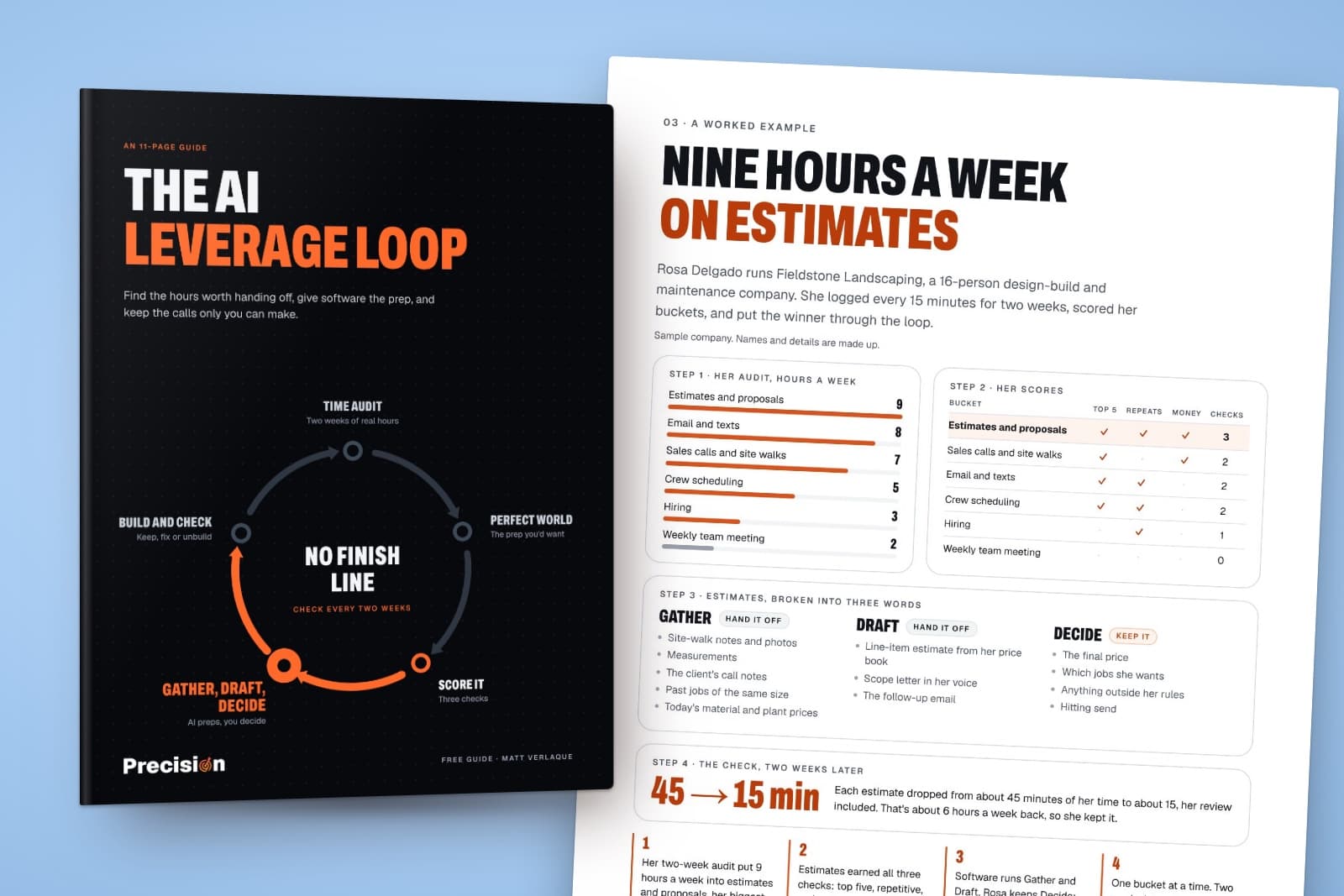
So you need a system you can run again and again. Draw a circle with five stops on it.
Stop 1: Audit where your time really goes
At least once or twice a year, track two normal weeks in 15-minute blocks.
Write down every block, from the time you wake up to the time you go to sleep. Get detailed, to the point where it feels a little weird.
A time audit fights hypotheticals.
Your calendar shows the real constraints in your business, because the problems nobody else can solve end up on your desk.
You can be busy and unproductive at the same time. For a lot of us, that's the default.
Group the blocks into buckets: sales calls, content, customer calls, quoting, whatever your week is made of.
I walk through the short version in where to start with AI.
Stop 2: Run the Perfect World exercise
For each big bucket, ask one question. In a perfect world, how would I have prepared for this?
Take a sales call. In a perfect world, I'd know how the prospect found us and which ad they clicked.
I'd know if they watched the video before the call, what their company does and whether we've ever talked. Probably a thousand other things.
If I could read all of that in 45 seconds before the call, would we have a better conversation? Of course we would.
Notice I didn't say I want to automate the sales call and never talk to the prospect.
You can over-automate a business and burn it to the ground. I've watched people do it.
The perfect world is about prep. It shows you what "ready" looks like for the work you already do.
Stop 3: Score the list and pick one
Put up to three check marks next to each bucket:
- Is it one of the top five places I spend time?
- Is the prep repetitive? When we don't like doing stuff, we don't do it.
- Does it make or keep money? Revenue and profit are the two scoreboards of business.
Three checks means you invest there. I'm a simple guy. It doesn't need to be complicated.
Notice who doesn't get a vote: the good idea fairy.
Every bucket on this list came from your real week, so you only solve problems that exist.
Stop 4: Break the job into Gather, Draft, Decide
This is the sauce. Almost any process breaks into three parts.
- Gather: pulling the inputs together.
- Draft: turning them into a first version.
- Decide: your judgment and the final call.
Automate Gather and Draft. Be much slower to automate Decide.
A worked example: the weekly newsletter
On that call, a founder wanted a better weekly newsletter.
Plenty of people would say, "I want to automate my newsletter so I never touch it again."
That isn't what gets good results. So we ran it through the perfect world, as if the newsletter were her only job.
Gather. Farm past customer calls for the questions people ask most. Keep every topic tied to the main problem the business solves.
Then study the outliers. Read 20 or 30 newsletters, in her field and outside it, and find the patterns.
Draft. Give the draft her voice: how she talks and the words she'd never use.
Add her beliefs, her stories and examples of what good looks like.
Ten years ago, a copywriter would have interviewed you for exactly this.
Decide. Topic selection, the edit and the approval. That stays with her.
Done by hand, the perfect-world Gather is around 20 hours of work before you write a word.
That's why it never happens, and why AI is worth pointing at it.
Don't skip the edit
I learned this one the hard way. I tried to reboot my LinkedIn and let a few AI posts go out without editing.
They were my real stories, voice-noted by me.
One was about getting called out for wearing beat-up boots while I was teaching at the fire department's training school.
The post was 1% off. Nobody else could tell, and I could. I should have edited it.
Treat AI the way you'd treat a human copywriter. They interview you, write the draft and put it on your desk.
You still edit it, because it's your name on it.
Why 80% is the target
Finance people know the materiality threshold. Getting a model 95% accurate is doable. Getting from 95% to 100% almost never pays back.
Automation works the same way. Gather and Draft are about 80% of the effort.
Chasing full automation is usually a fool's errand. Even when it works, the output tends to be worse than yours.
The last 20% is taste, judgment and high-stakes calls. Keep it. Your business loses its soul if you outsource that.
Stop 5: Build it, then check it
Build the Gather and Draft for that one job. Then check it in a couple of weeks:
- Is it saving time?
- Is it saving or earning money?
Every build costs money. I don't mean the subscription. I mean your focus and your time.
If it misses, you get to decide. Keep investing, or admit it was the wrong thing to automate and shut it down.
Throwing a build in the bin now and then is the tax on innovating. Try not to pay it every two weeks.
Then go back to the top of the circle and run the loop on your next bucket.
Every couple of weeks or every month, you buy back a little more of your calendar.
What this looks like in my business
Every morning at 7 AM, a report lands in our team chat.
It reads what our customers and prospects are saying everywhere: sales calls, coaching calls, support email and chat threads.
It gives me the top three themes, the positives, and the negatives, split into active customers and prospects.
Every theme comes with receipts: the real quote, the call and the timestamp.
On Friday, it rolls up the week.
That's a heck of a Gather. It chews through pages and pages of conversation I would never read myself.
What we do about it is still my call.
Keep your data where you can take it with you
The nerds call this data sovereignty. In plain English: keep your business information and context separate from any one AI tool.
The best tool today won't be the best tool in three months. If your history lives in one app, you're stuck with it.
Common mistakes
- Starting with the tool. The wrong question is "where do I install AI?" Start with your calendar.
- Automating work you've never done. Use AI on work you already do, or work nobody has time for. New ideas are still a human job.
- Automating Decide. That's where your judgment lives.
- Skipping the check. If it doesn't save time or money, it's a hobby.
Run it this week
Grab the free guide for the printable 15-minute daily log, the scoring sheet and a worked sample company, then start your two-week audit tomorrow morning.