Twelve people pick version A, eight pick version B, and we call A the winner. Most of us have done it.
That isn't a test. A small company might need to run a real split test for six months before the result means anything.
So skip it. There's a simpler way to get a straight answer.
Is the change even the problem?
Check this first. If your team isn't running the current process well, a new one won't save you.
A poor process executed properly will typically outperform a great process executed poorly.
So rule out execution before you change anything. If you can't rule it out, fix that first.
What's the simple way to test a change?
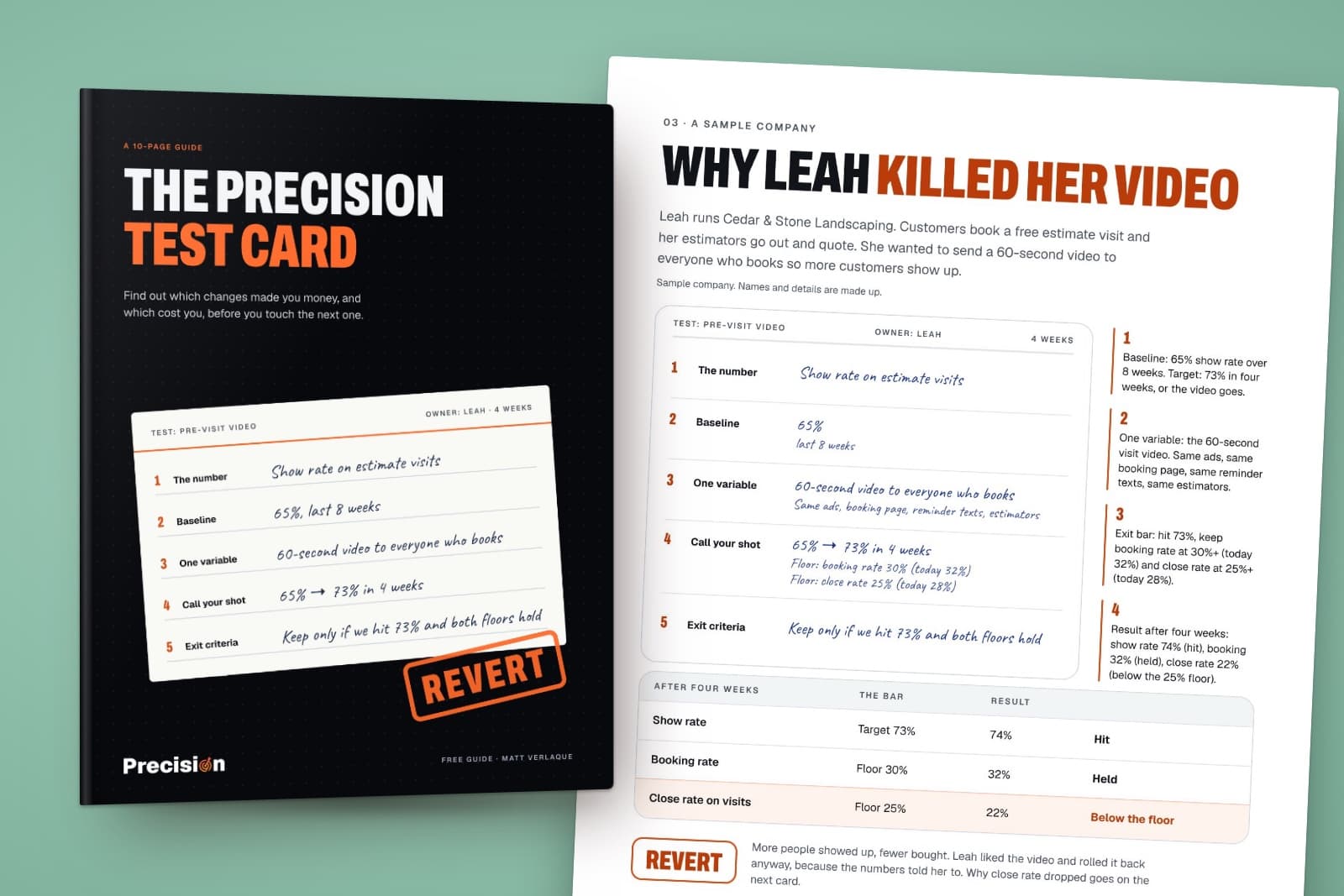
Five steps:
- Pick one metric. The number you expect to move.
- Get a baseline. Where that number sits today. If you can't pull it, measure for a couple of weeks first.
- Change one variable. Change three things and you won't know which one worked.
- Call your shot. Write what will change, by how much and by when. Add counter-metrics: numbers that must not get worse.
- Set exit criteria. Decide what has to be true to keep the change.
The full method, with a worked example, is in the Precision Test Framework.
Why go back to the old way if the test misses?
Because that's the default. If the test doesn't hit the exit criteria, you go back to what you were doing before.
Most of us do the opposite. We try something, and as long as it doesn't burn the business down, we keep it.
Defaulting to revert is how you stop terrorizing your team with constant change.
How do I test a new idea before I build it?
Market it first. You want an asymmetric bet: a big upside if it works, a small downside if it doesn't.
Building first is the opposite. You sink the money, the time and the effort, take it to market and find out nobody wants it.
If the idea is for new customers, market and sell it before you build it. Run a few ads, put up a landing page, start a waitlist.
If they won't even join the waitlist, you have nothing to build.
For existing customers, try a painted door. Put the button or menu item in front of them before the thing exists.
If they don't click, they don't care. If they do, ask how they'd expect it to work.
Be careful with people who already pay you. Don't get them excited about something you may never build. Tell them plainly that you're doing research.
Can AI tell me if the idea will work?
Not really. AI makes building a lot easier, but it can't tell you whether the thing matters.
I score ideas one to five on three things:
- Impact: what share of my customers it would help.
- Confidence: how sure I am that it'll work.
- Ease: how easy it is to build.
AI changes ease a lot. It doesn't change impact.
It can even push your confidence the wrong way, because AI is really good at telling us what we want to hear.
Where do I start?
Pick the next change you're about to make. Before it goes live, write down the one metric, the baseline and what has to be true to keep it.
The free Precision Test Card gives you a one-page version to fill out.