On a Precision coaching call in August, I asked a group of founders to finish a phrase in the chat. The only constant is what?
A bunch of them got it right away. Change.
Then I asked what makes change hard in their own business. The answers came in fast.
A new process sticks for two weeks, then everyone slides back to the old way. The team won't buy in. Nobody has the bandwidth.
Most founders love change. It's part of why we started businesses: every day is different.
I have a great team, and I still worry about how much change they can take. Every human has a finite capacity for it.
The Precision Test Framework is how I change things without wearing my team out.
It's more scientific than "let's try it and see," and far less work than hiring a data scientist.
Three ways founders test wrong
1. Fake split tests. We read about A/B tests from companies with massive web traffic, and we want to run one too.
Most of us don't have the numbers. Twelve people pick A, eight pick B, and we call A the winner.
To reach real statistical significance, a small company might need to run the test for six freaking months. That does precisely nothing for you.
2. Defaulting to change. I have this problem, so I build systems to fight it.
Constant change makes us feel good and makes our teams feel bad. Eventually they stop putting up with it.
3. Changing the process to fix poor execution. If people underperform in the old process, they'll underperform in the new one.
A poor process executed well will typically outperform a great process executed poorly.
So solve execution first. If nobody clearly owns the work, start with how you delegate.
Which changes this is for
Most of your decisions are two-way doors. You can make the call, then unmake it if it doesn't work.
A price change, an onboarding fee, a new feature, even a positioning statement. Some are slower to undo, and you can still undo them.
A few are one-way doors, like parting ways with a leader. Those are hard to test, so think them through with something like the Clarity Memo.
Two-way doors are 90 to 95% of the changes you'll make. This framework is built for them.
Step 1: Pick one metric
Shocker, I know. You need a number you expect the change to move. One, maybe two at most.
Measure the people the change touches. Add something to onboarding, then compare those customers' 60- or 90-day retention with similar customers who didn't get it.
What if you aren't measuring it yet? Then measuring it is the first step of the test.
At least 30 to 40% of the quarterly projects I've owned started with figuring out how to measure the thing.
Your business isn't broken. You just need to start counting.
Step 2: Get a baseline
You can't measure change if you don't know where you started.
If you can't pull the history, spend a couple of weeks measuring before you touch anything. It's part of the work, so don't skip it.
Step 3: Change one variable
The most common mistake is changing more than one thing at a time.
Notice the word doesn't end in S. One variable.
Testing three changes at once is seductive.
If the test fails, you don't know why. If it works, you still don't know why.
Kevin Dorsey has built sales teams at billion-dollar companies. I heard him say it in a talk: if you can't tell me why you're winning, you're not winning.
When you start winning, you want to do more of it. You can't if you don't know what worked.
Step 4: Call your shot
Now you're ready. Write down the hypothesis: what will change, by how much, and by when.
Then protect the downside with counter-metrics. These are numbers that must not get worse while you chase the one you want.
Don't turn them into more goals. Each one is a floor, a line the number can't drop below.
Raise prices and you'll lose some customers. That's okay. Write down the point where it stops making sense.
Step 5: Set exit criteria and default to revert
Exit criteria answer my favorite question: what needs to be true?
Here, it's what needs to be true for you to keep the change.
Notice the default. If the test misses, you go back to how things were.
That one rule is how you stop terrorizing your team.
Most of us run an experiment, and as long as it doesn't burn the business down, we keep it.
The only constant shouldn't be change. It should be testing.
A worked example: the onboarding fee
A software founder on the call wanted to start charging new customers an onboarding fee. Here's how the framework plays out on it.
- Metric: onboarding fees collected.
- Baseline: zero today, plus the current close rate and what onboarding costs to deliver.
- Variable: add the fee. Leave the monthly price and the offer alone.
- Hypothesis: $10,000 in onboarding fees in one month.
That sounds like a clean win. So I asked the group what could make it true and still hurt the business.
Counter-metric one: the cost to deliver. Charge $2,500 for onboarding that costs $5,000 to deliver, and every sale loses money. Your gross margin has to hold.
Counter-metric two: close rate. Say the fee knocks 15 percentage points off it.
Now each customer costs more to win and takes longer to pay that back. You can run out of cash while collecting more of it.
Exit criteria: keep the fee if it brings in $10,000, onboarding stays profitable and close rate holds above a floor you set first.
Miss any of them and the fee goes away.
Maybe you'd accept a 5-point drop in close rate to triple the cash from setup fees. Fine. Decide that before the test starts.
Explain it to your team this way
Say you want to lift trial-to-paid conversion from 65% to 73% in four weeks.
Tell the team you know it's 65% because you measure it weekly. Name the one change and what has to be true to keep it.
Tell them the default is to revert, and what 73% would mean for the business. Then ask if they'll run the test with you.
They'll see you've thought it through. Skip that, and the team hears made-up work.
Test it before you build it
For a new feature or service, run the cheapest test first. Put up a painted door: market the thing before it exists.
I took this from Ryan Levesque's book Ask. He'd run ads on an idea the moment he had it. No clicks, probably not a good idea.
If people click, build a landing page or a waitlist. If they won't even join the waitlist, you have nothing to build.
Testing with marketing is far cheaper than building first and then testing with marketing anyway.
Know your dozen numbers
When I ran SaaS Academy, I reviewed 387 data points every Monday morning. I loved it, and most teams won't keep up with that.
Your car's dashboard shows about a dozen things, and the diagnostic port holds tens of thousands of codes.
Run the business on about a dozen numbers everyone on the team can explain. Pull the rest when you're running a test.
And when a number moves, good or bad, find out what changed before you change anything.
That's easy when the news is bad. It takes real discipline when the news is good.
Common mistakes
- Calling 20 visitors a split test. You need far more data.
- Changing three things at once. Win or lose, you learn nothing.
- Rewriting a process your team isn't following yet. Fix execution first.
- A hypothesis with no deadline. "Better close rate" isn't a test.
- Counter-metrics as extra goals. They're floors.
- Keeping a change because nothing broke. The default is revert.
Run your next change this way
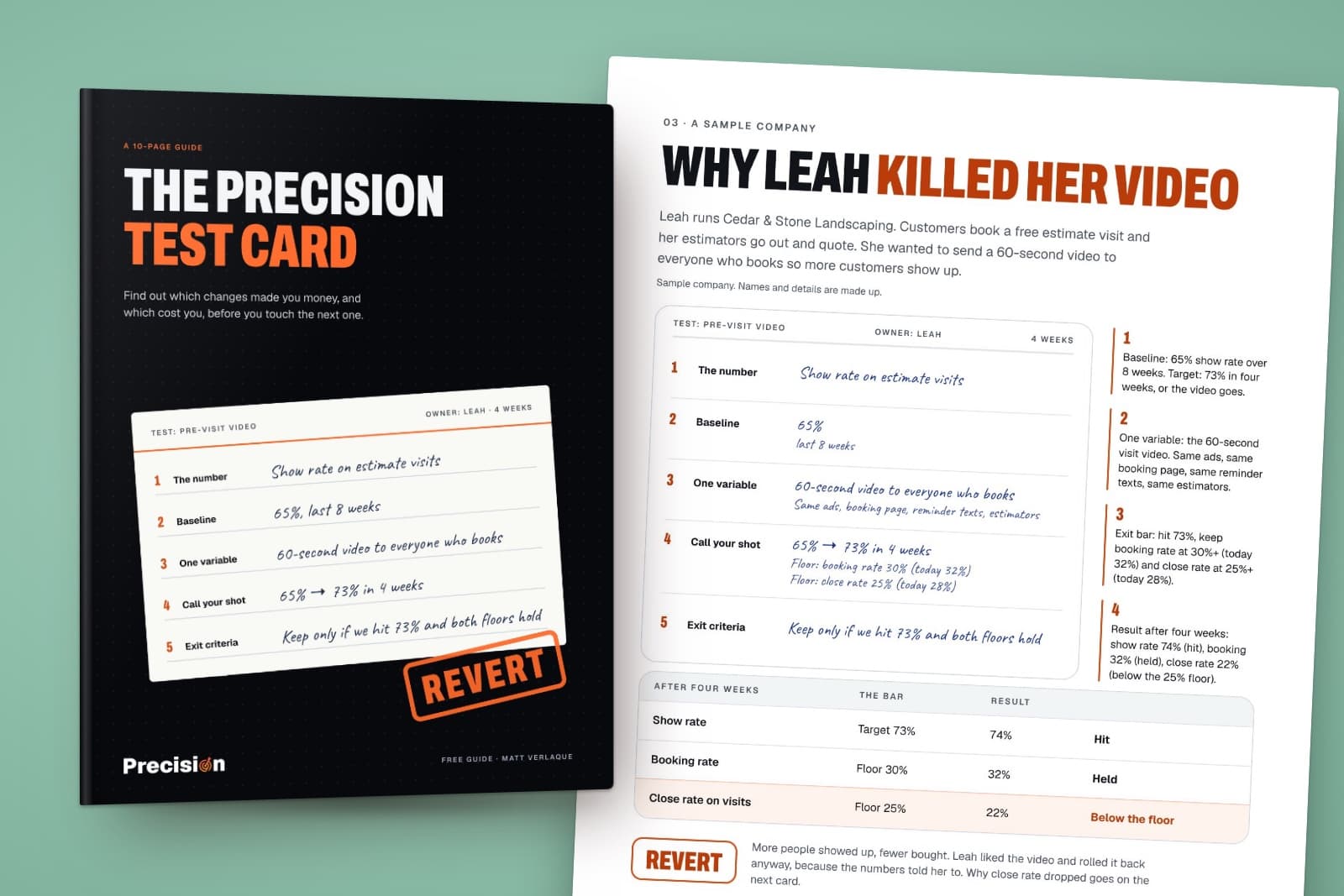
Grab the free guide for the printable test card and a worked example, then fill one out before your next change goes live.