On a Precision coaching call in November, I asked a group of founders who had ever written an SOP.
Every hand should go up. Most of those SOPs are out of date, and most of us hate writing them.
One founder named the real problem right at the start of the call: I've said this stuff a thousand times.
That's the job a skill does. You write down how the work gets done once, and AI follows it every time.
What a skill actually is
In AI land, a skill is a literal text file. A good one is a folder with a main file and a few reference files.
Together, they teach AI how to follow one process.
What's the human version? Three letters. SOP.
A skill is an SOP for the AI age.
And it behaves like an SOP. A person follows some of it, some of the time, on a good day. AI is about the same.
The better it's written, and the more examples it has of what good looks like, the more often it gets followed.
First, find where you are: the AI Maturity Matrix
First, see where skills fit. I draw it as a graph with two lines.
The vertical line is autonomy: can it work without you driving it?
- Bottom: chat. You type, it answers. When you walk away, it stops.
- Middle: scheduled tasks. It runs on a schedule, though often still on your computer.
- Top: scheduled, on its own computer. It runs in the cloud, and your laptop isn't involved.
The horizontal line is intelligence, and smart doesn't mean benchmarks. It means it knows how your business works.
- Left: copy-paste. You paste in a customer's refund request and ask what to do. It hands you generic principles, and you still have to make the same decision. I call this the corner of despair.
- Middle: skills. You can say "review this sales call" and trust it to follow your process most of the time.
- Right: skills plus memory. It has a place to write things down, so it doesn't forget what happened last week.
The goal is up and to the right.
It's what you'd want from a good hire. A person has their own laptop, a work schedule, SOPs to follow and a memory.
Good people, good AI, same thing.
Plenty of tools climb the vertical out of the box now. The horizontal is the real work, and you can't farm it out.
Every business has some secret sauce. Nobody else can write it down for you.
Use the same graph to judge the next tool everyone's yelling about.
Can it run on a schedule? Does it work off your laptop? Can you teach it your process? Does it remember?
Ignore the ding-dongs fighting about which model is best this week. You run a business. Make your own buying decisions.
Roles are made of many skills
Don't build one bot that does everything. A role is a stack of skills, the same way a job description is a stack of tasks.
When we set this up, we start with three roles, each with one first skill:
- Chief of staff: inbox triage and open loops.
- Chief revenue: pipeline tracking, and sales call reviews if you sell on calls.
- Chief ops: a daily or weekly snapshot of the numbers.
Then you add more. AI now does about 90% of our chief of staff's job from a year ago.
It got there one skill at a time.
The 5 R's of a skill
Every good skill has five parts. I call them the 5 R's.
We'll build one as we go: a sales call review that grades every call your team runs.
1. Reference: start from what's already true
When you write an SOP, you look up the best practices first. You don't invent a sales script from scratch.
Founders do that a lot. We wing our own calls, then hire someone, then make something up, then wonder why it doesn't work.
The reference holds the universal truths. For a sales call:
- Do real discovery.
- Find the problem and put a dollar cost on it, so the price looks small next to it.
- Ask for the sale. If you don't ask, a lot of people won't buy.
- Handle objections instead of accepting the first one and sending a proposal.
Pull from books and trainings you trust.
For our follow-up skill, we put in Chris Voss's one-line question from Never Split the Difference: "Have you given up on this project?" It gets replies.
2. Rules: make it yours
References won't fit every business. Rules customize them.
How you position your offer is different from the founder next to you. So is your culture.
Some teams sell harder. Some sell more consultatively.
Deal size changes things too. A big multi-year deal and a month-to-month plan don't run the same call.
The reference says you should do discovery. The rules say how your team does it.
3. Rhythm: it runs without you
I don't want you starting every piece of work by hand. That doesn't take anything off your plate.
Rhythm is the schedule or trigger: "every time X happens, I want Y."
Our sales call review checks the team's call recordings every hour during business hours.
When it finds a new one, it reviews it and posts it in our team chat.
Every morning it sweeps for anything that happened after hours, in case something got missed.
It's simple, and it's arguably the most important part. If the work doesn't happen without you, it's not that exciting.
4. Runbook: the steps
This is the part everybody thinks is the skill. I borrowed the word from software engineers.
It's the list of steps, the meat of the SOP.
For our review, that's the seven phases of a sales call and what to grade in each.
Some lines the rep has to say. Other points just need to come up, whether the prospect volunteers them or not.
Put an example of a great call, and a great review, right in the skill.
Without one, AI tends to invent names and details that mean nothing.
For writing this part well, I learned the most from Jason Cohen. His version splits a skill into premise, posture, process and pushback.
Skip the posture and pushback, and you get the yes-man AI that tells you every idea is great.
5. Result: what comes out
What does it produce, and where does it land?
A doc, a message, an email, a post in your team chat, or a note saved somewhere for later.
Be specific about what it makes and who reads it. Ours is a written review in the sales channel, where the whole team sees it.
The worked example, all five together
| R | Sales call review |
|---|---|
| Reference | Discovery, put a cost on the problem, ask for the sale, handle objections |
| Rules | Your offer, your sales style, your deal size |
| Rhythm | Checks recordings hourly in business hours, plus a morning sweep |
| Runbook | Seven call phases, what to grade in each, one example of great |
| Result | A review posted in the team chat |
Common mistakes
- Living in copy-paste. If it only works while you're sitting there, you're still in the corner of despair.
- One bot for everything. Split roles into skills.
- Skipping the reference. You reinvent a worse version of what's already known.
- No rhythm. If you have to remember to run it, you won't.
- No example of good. AI fills the gap with made-up details.
- Outsourcing the secret sauce. You got here because of how you do things. Farm that out and your business loses what makes it yours.
Still figuring out which job to hand off first? Start with where to start with AI.
A skill is also how you delegate to AI, the same way you would to a person.
Write your first one this week
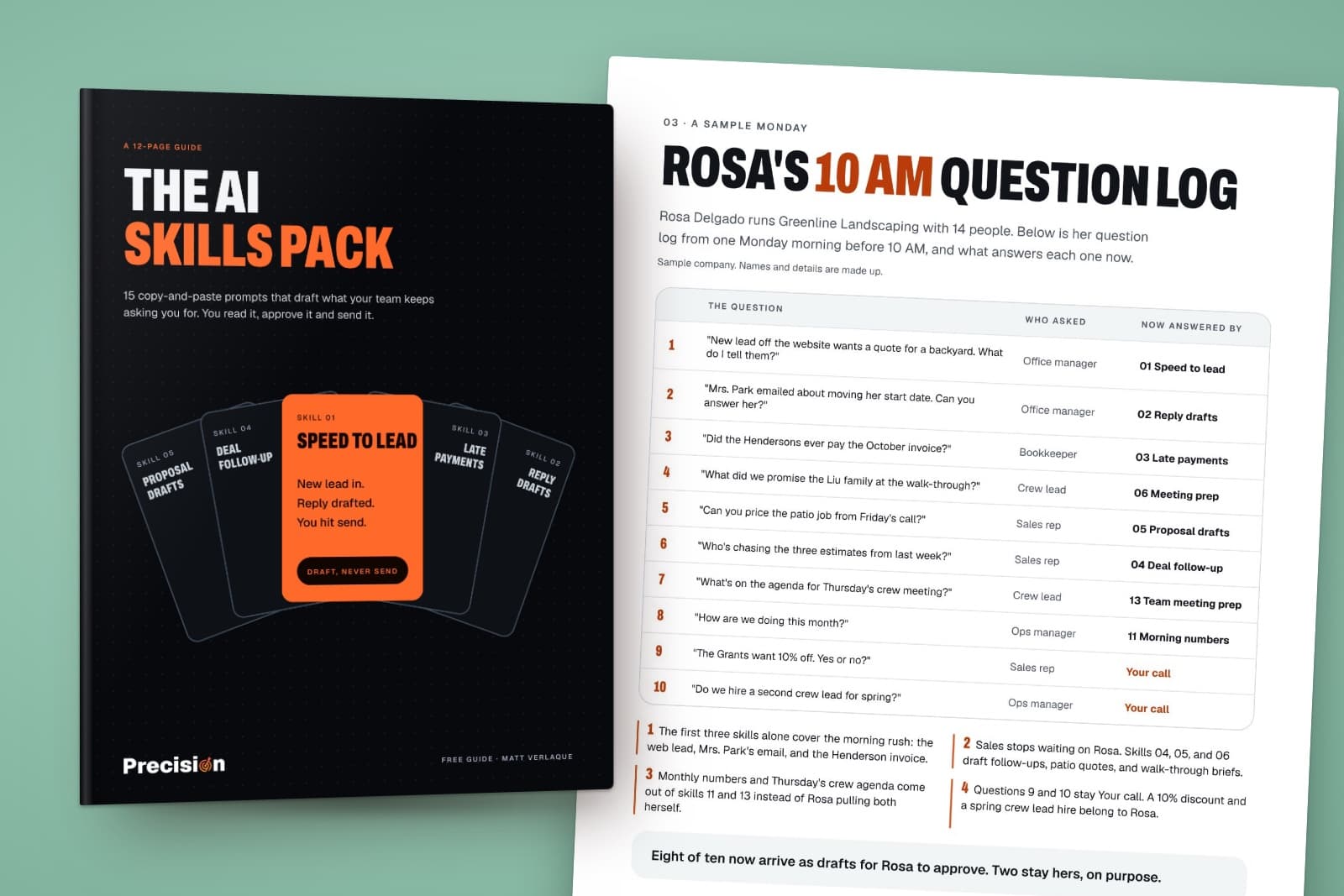
Grab the free AI Skills Pack for 15 ready skills to paste in today. Then write your own for the job you've explained a thousand times.