You planned the week. By Wednesday it's gone.
The big priority never got started. Your calendar is full of things you said yes to.
Slack ate your afternoons, and you spent Friday on work someone else should have done.
I'm a productivity nerd. I've read most of what's been written on this and tried way too many tools.
That means I've also failed in almost every way imaginable. When I look back at why, it comes down to four behaviors.
I call them the Time Sabotage Diamond. Then there's a weekly check that catches which one got you, so you can fix it next week.
The point of all of it is the feedback loop. Without one, you have no idea whether the moves you're making work.
Draw the diamond
Draw a box in the middle of a page and a diamond around it. Put one failure mode on each point: avoidance at the top, then overcommitting, interrupting and unimportant.
Most of us trip over all four. Notice which one you trip over most.
Avoidance: you know the priority and still don't start
You know what matters. Either it makes you uncomfortable, so you fill the day with easier things, or it's so big you don't know where to start.
The fix comes from a course I took from the Flow Research Collective, Steven Kotler's company. Break every big, meaty item into very small tasks.
Then load the first step straight into the calendar invite.
"Review six months of financials" is a block nobody wants to open.
The invite instead says: link to QuickBooks, first report to pull, and the three questions you need answered. Now there's nothing to figure out when the time comes.
Once you take the first step, the rest usually get a lot easier.
Overcommitting: the calendar prison
If you love saying yes, this one's yours. Forty ounces in a 20-ounce cup.
I still fight it. I'll build myself a calendar prison and then be sad that I'm sitting in it.
The fix is one sentence to your team: "I'm not getting involved in that."
Say it exactly that way, without the fluff. Skip "I think you can handle this." It's a boundary, and it's not open for discussion.
Most of our problems are boundary problems.
Commit to saying it three times this week. You'll have to pick something, and I promise you're involved in things you shouldn't be.
Interrupting: the digital tap on the shoulder
This is different from overcommitting. It's the inability to say no when people ping you.
"Got a minute?" "What do you think about this?"
Just because someone asks for your feedback doesn't mean you owe it to them.
Set your phone so people only get through if they call twice. Turn off Slack and email notifications and check them when you choose.
With very few exceptions, nobody can burn your business to the ground in two hours. It takes real talent.
A lot of interruptions are people who already know the answer and don't want to make the call alone. That's a coaching opportunity.
Most of the time, hand it back.
Unimportant: playing below your pay grade
You can attack the right number of things, protect the time and kill the notifications. If the work isn't important enough, you still lose.
This is work you shouldn't be doing, work that doesn't need doing at all, or work you should delegate.
Our teams are often better than we give them credit for. And a lot of the time, we aren't as good as we think we are.
"Only I can do this right" is usually a story we tell ourselves.
Don't abdicate everything, though. Sometimes they really need you to get in there and give feedback.
The center: dialed in
In the box in the middle, write dialed in. It's the opposite of all four, and it means four things are true:
- The right amount of work is on the calendar.
- It's protected from other people messing it up.
- Everything on it is important enough to justify doing.
- You attack it like a wild animal and get it done as fast as humanly possible.
None of us live there all the time. We oscillate.
The only way to know you've drifted is to write down how the day went and check it.
The Reckoning: your weekly feedback loop
This builds on a daily note. Each morning, write down your non-negotiables and what you're committing to. Each evening, write down what happened.
The tool doesn't matter. Write it in a notes app or on paper.
For the end of the week, a teammate built an AI prompt that reads those notes. We call it The Reckoning, which is a little dramatic.
Drop in the week's notes and it does four things:
- Asks what got done. Which commitments did you follow through on?
- Scores the week. If you did what you said, it tells you so.
- Names the failure mode. Every miss gets sorted into one of the four points of the diamond.
- Gives you one to three fixes for next week.
It takes about 10 minutes. You can build it in ChatGPT, Claude or whatever tool you already use.
It won't tell you which project your business needs. It checks whether you did what you said you'd do.
Writing it down is about two-thirds of the battle. Checking whether you followed through is the third we usually skip.
A worked example
These numbers are made up. Say your daily notes show five big commitments this week, and you hit three.
The financial review never happened. That's avoidance: the block said "financials" and nothing else.
Fix: load the first step into next week's invite.
The hiring plan slipped because you joined four meetings you didn't need to be in. That's overcommitting.
Fix: say "I'm not getting involved in that" three times before Friday.
Two misses, two fixes, both on the calendar before Monday.
Common mistakes
- Planning without checking. The plan isn't the feedback loop.
- Blaming the tool. Index cards work. So does a markdown file.
- Softening the boundary. "Maybe you could handle this?" invites a debate.
- Answering every ping. It trains people to ping you.
- Treating every task as yours. Raise the bar on what earns your time.
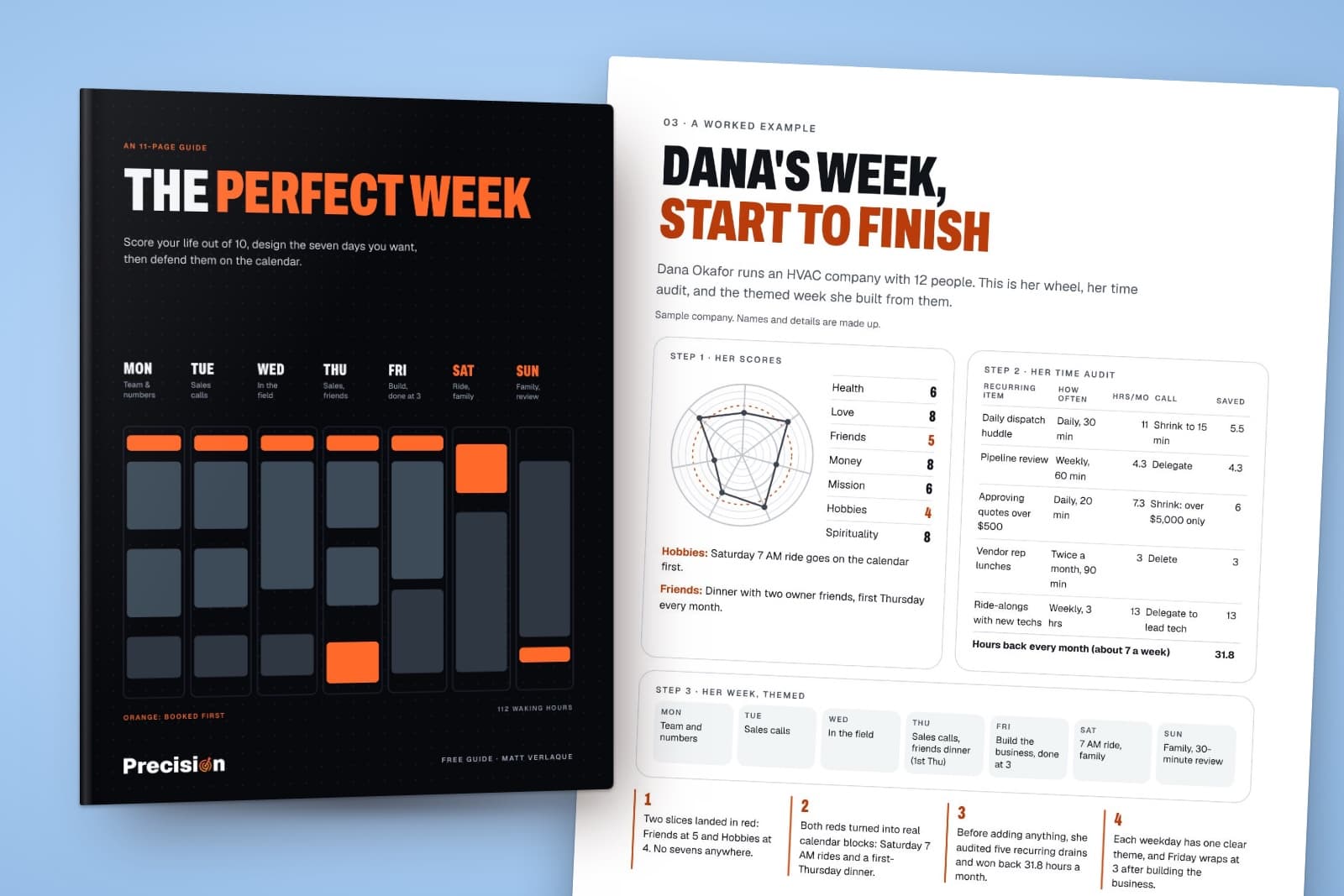
If you don't have a planned week to check against yet, start with the Perfect Week, then run your first Reckoning next Friday.
For the short version on defending your calendar, see how to protect your time as a CEO.