Your calendar is the most expensive document in your entire company. Put your focus on an area of the business, and your team steps up there too.
Most of us let other people write on it. Half the time we don't even know what's on it.
You don't need a new app. You need to play defense.
How do I block time without it getting eaten?
Pre-fill your calendar with heads-down time two or three weeks out. I call it unallocated heads-down time.
When a meeting needs a slot, you take it out of that time, on purpose. Sometimes the meeting wins. That's fine, as long as you decided.
I do my best work in the morning, so I book meetings backward from the end of the day when I can.
Skip this and you say yes to every request. Three weeks later you realize you haven't done your own work.
Isn't a full calendar the problem?
Only if it's full of other people's stuff. You fill the calendar to play defense against things stealing your time.
Picture your calendar from above, like farmland in little square plots. Every block of heads-down time is a fence around one.
You're living all 24 hours either way. An empty slot just means anybody can claim it.
Where should recurring CEO work go?
On the calendar, not in a task app. You make the decision once, then follow the calendar.
Every Monday afternoon, I have a recurring invite to review cash flow. Two days after the books close each month, there's another for the financial review.
Put the bullet points and links you need right in the invite. Then there's nothing to decide when the time comes.
Why do I keep overworking anyway?
There are four usual culprits. I call them the Time Sabotage Diamond, and I've tripped over all four.
- Avoidance. You know the priority, but it's uncomfortable or too big to start. Break it down and load the first step right into the calendar invite.
- Overcommitting. You say yes to everything and build yourself a calendar prison. Practice one sentence with your team: "I'm not getting involved in that."
- Interruptions. People tap you on the shoulder for answers they already have. Turn off notifications, close Slack and hand the question back.
- Unimportant work. You're doing work below your pay grade that could be delegated or doesn't need doing at all.
Most of our problems are boundary problems.
What do I do with what I didn't get to?
Look at it every evening and force yourself to put it somewhere. If you skipped it and nothing bad happened, it wasn't a priority. Delete it.
If it does matter, something else has to come off the calendar to make room. Decide that now, before it turns into working on Sunday.
Should I hand off everything?
No. Keep 10 to 15% of your time for checking on the work.
I listen to sales calls and read what my team sends out. It's not a trust thing. It lets us catch a two-degree miss before it's a months-long fire.
Avoidance is not a strategy.
Where do I start?
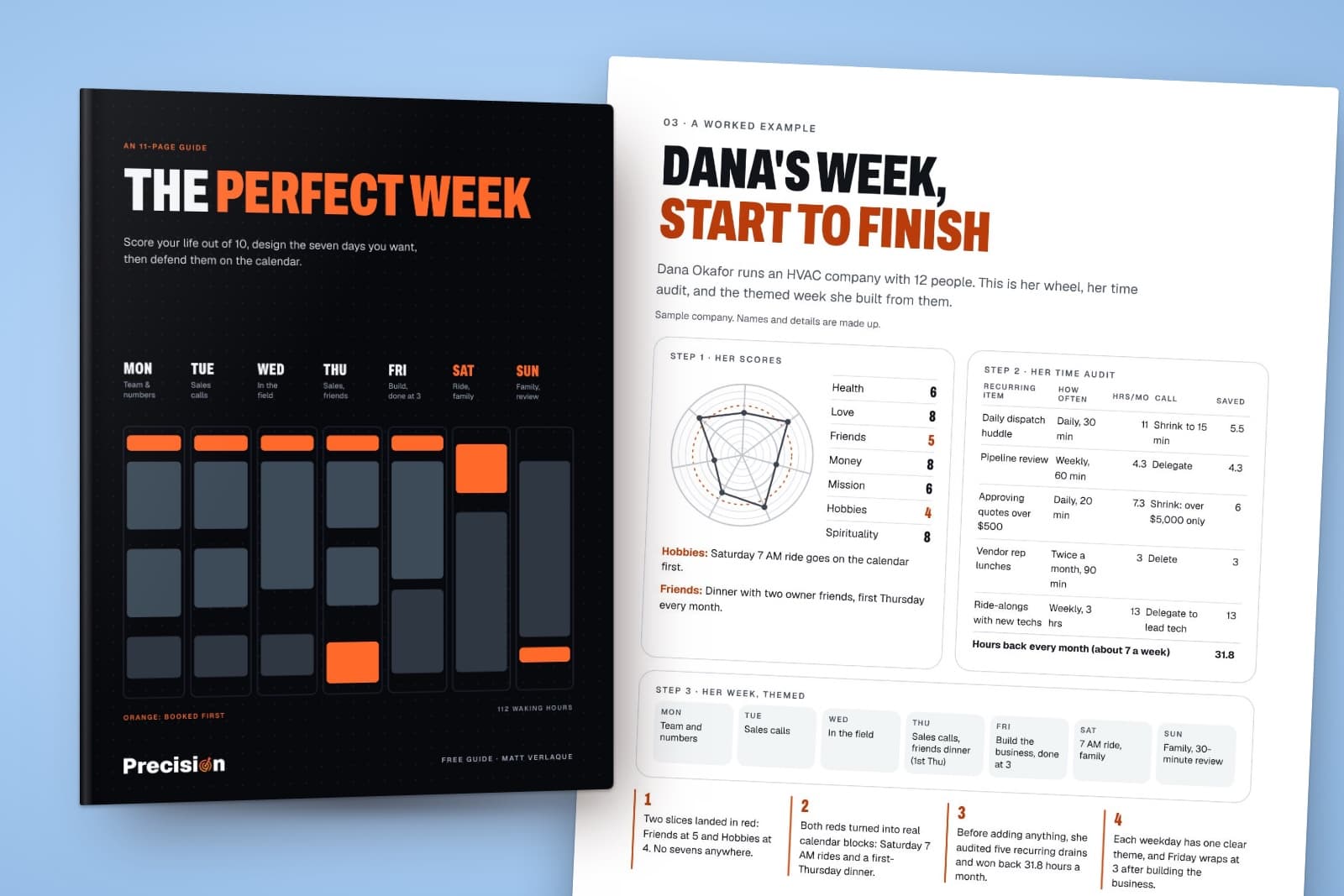
Build your Perfect Week, a plan for what a great week looks like, then defend it. The framework comes from Dan Martell.