A founder on one of our coaching calls said his company was cash strong, at least by the books.
In real life, he was moving money between accounts every payroll week, waiting on customer payments to land.
I told him what I'll tell you. There's no such thing as cash strong on paper. Cash is cash.
Most of us watch two numbers: revenue and the bank balance. They're not enough.
These are the ones I'd watch, and how often.
What should I look at every week?
Cash. Specifically, a 13-week rolling cash flow.
It's a spreadsheet. For each of the next 13 weeks, it lists the cash you expect to come in and go out.
I review ours every Monday. Outside our weekly team call, it's my most sacred Monday activity.
I don't know a lot, but I know if I run out of cash, we die.
Your bookkeeper or accountant can build it for you. You just need someone in your numbers keeping it current.
Why isn't my P&L enough?
Because profit runs in a line, and cash runs in a cycle.
Revenue goes up or down over the months. Your cash swings every few weeks with payroll, card bills and when customers pay.
The 13-week view shows you that cycle. You'll learn your usual low point and high point, and stop getting surprised.
It answers two questions. Will we run out? And are we sitting on cash we could put to work?
The second one matters too. If you don't trust your numbers, you won't invest, and you'll grow slower than you could.
I use it before big decisions. When I was thinking about a hire, I plugged the salary into the next three months.
I could see exactly what it did to our cash.
What tells me if growth is healthy?
Gross margin. It's what's left of revenue after you pay to deliver what you sold.
Revenue shows how much money comes in. Profit is the finish line. Neither one tells you how the business will perform as it grows.
Gross margin does. That's why the best investors obsess over it.
Watch it every month. A cut to your delivery costs earns more on every customer you'll ever add.
A cut to overhead saves the same flat amount forever.
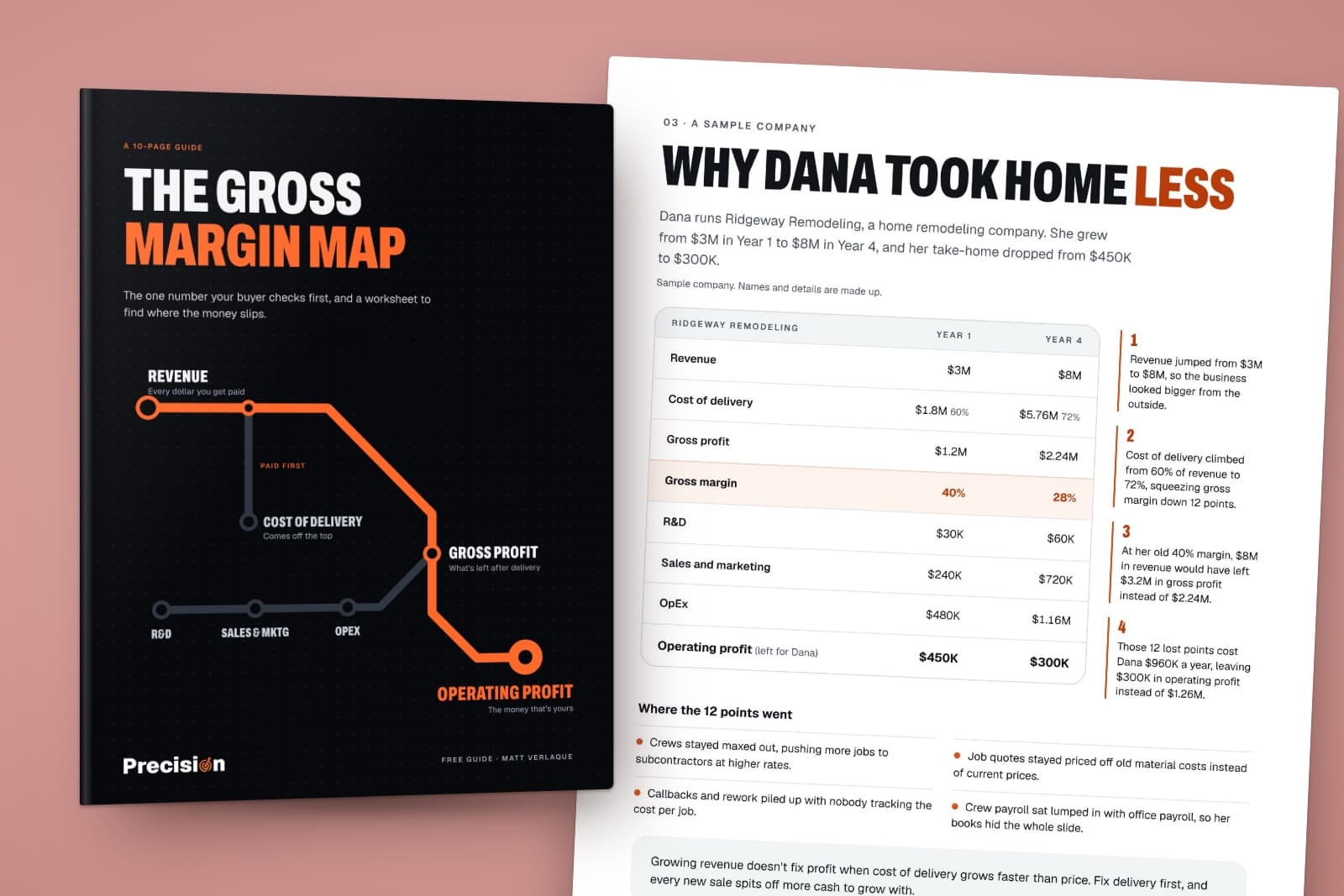
I teach the full method, with a worked example, in the Gross Margin Map.
Is my marketing spend paying back?
Most of us measure how fast a new customer pays back what it cost to win them. Then we do the math on revenue.
Do it on gross profit instead. Money you spend on delivery was never yours to reinvest.
So payback takes longer than it looks on revenue.
How do I keep from overreacting to big numbers?
Read every expense as a percentage of revenue.
Money is a weird thing. Most of us get emotional about numbers bigger than the ones we saw growing up.
As the business grows, every number gets bigger. A cost that feels huge might be tiny next to revenue, or the other way around.
Percentages let you put the right urgency on the right number.
One founder on our calls set up a monthly report of expenses as a percentage of revenue.
He showed his leadership team the percentages, with no dollar figures.
This time, they could see where they were redlining, and why he was pushing where he was.
How much should my team see?
I share everything up to revenue with the whole team: leads, sales, retention, revenue.
Your leadership team should see all the way down to net profit. But teach them first.
What you share is secondary to what you teach. Skip the teaching, and people assume every dollar of revenue lands in the CEO's pocket.
Once they're taught, send a monthly report ahead of the meeting. Each leader brings one thing they learned from it and one question.
Where do I start?
Ask your bookkeeper for a 13-week rolling cash flow this week. Put a Monday review on your calendar and protect that time.
Then pull your last P&L and find your gross margin.